Switzerland doesn’t have obvious raw materials for watchmaking. No silver mines, no gem deposits, no rivers running through metal-rich soil. What it had, starting in the 16th century, was a combination of religious refugees with precision craft skills, winters long enough to make indoor work a necessity, and a decentralized network of villages where division of labor happened naturally across valleys and hillsides. That’s where Swiss watchmaking comes from. Not from a particular genius inventor or a royal commission, but from geography and circumstance.
The Beginning: Geneva and the Huguenots
Geneva in the mid-1500s was receiving Protestant refugees from France. Among them were goldsmiths and jewelers, and they brought the craft traditions of French luxury goods making. Around the same time, John Calvin’s sumptuary laws in Geneva banned the wearing of jewelry. Goldsmiths needed a new product. Watches, which had recently migrated from portable clocks to wearable objects, were a natural fit. They were functional, not decorative, and Calvin’s prohibitions didn’t cover them. By the late 1500s, Geneva had a functioning watchmaking guild.
The Jura region, which runs along the French-Swiss border, developed differently. There, farming communities took up watchmaking as winter work. The tools were simple enough to use in small workshops, the work could be divided across families (one making springs, another making wheels, another finishing cases), and the finished goods could be transported to Geneva and eventually exported. This cottage industry model was what allowed Swiss watchmaking to scale without factories.
The 18th Century: Enlightenment and Precision
By the 1700s, Swiss watches were exporting across Europe and into Asia. Abraham-Louis Breguet, arguably the most significant watchmaker of the period, was French-born but spent much of his career in Geneva. He developed or refined many of the mechanisms still in use today: the tourbillon (patented in 1801), the overcoil hairspring, and the first wristwatch, made in 1812 for the Queen of Naples. Breguet’s notebooks still exist, and reading through them is a strange experience because the problems he was solving, isochronism in the hairspring, shock protection for delicate components, are the same problems watchmakers still deal with.
The Cabinotiers, a class of independent Geneva watchmakers who worked from small studios (cabinets) in their homes, dominated the high end. They produced complicated watches, pocket watches with minute repeaters, perpetual calendars, and astronomical displays, which were sold to European courts and wealthy collectors. The work was slow and individual. A single complicated pocket watch might take years to complete.
The 19th Century: Industry Arrives
American watchmaking firms in the mid-1800s introduced mechanized production and interchangeable parts, which allowed them to make watches faster and more cheaply than Swiss cottage workshops could. The Swiss response, which took decades, was to modernize while protecting the quality that justified premium pricing. Le Locle and La Chaux-de-Fonds became centers of an organized watchmaking industry with specialized suppliers, trained apprentices, and something approaching quality control.
It was during this period that many of the brands still active today were established. Patek Philippe was founded in Geneva in 1839. Audemars Piguet was founded in Le Brassus in 1875. Cartier began as a Parisian jeweler but started working with Swiss movements in the 1880s. Longines, founded in 1832 in Saint-Imier, was one of the first Swiss makers to adopt mechanical production methods and became one of the larger exporters of the period.
The 20th Century: Wristwatches and World War
Pocket watches dominated until roughly World War I. Military necessity changed that. Officers needed to coordinate timing without taking a hand off whatever they were holding, and wristwatches, previously considered feminine accessories, became standard-issue field equipment. By the end of the war, demand for wristwatches had transformed the market permanently.
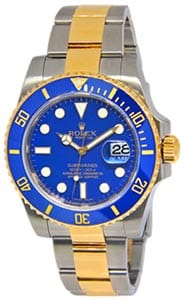
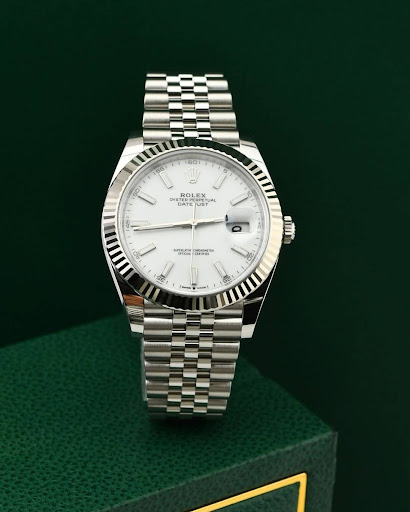
Hans Wilsdorf founded Rolex in London in 1905, though the company relocated to Geneva in 1919. The early Rolex story is largely about solving practical problems. In 1926 they introduced the Oyster case, the first waterproof wristwatch case, and in 1931 the Perpetual rotor, an automatic winding mechanism that charged the mainspring through wrist motion. Both were genuine advances. The Oyster Perpetual Datejust in 1945 added a date display and became one of the most widely recognized watch designs of the century.
During World War II, Switzerland remained neutral, which meant Swiss watch production continued while factories elsewhere converted to war work. Swiss makers supplied both Allied and Axis customers. It’s an uncomfortable piece of history, but it also meant that Swiss watchmaking infrastructure survived the war intact while German and Japanese watch industries were significantly disrupted.
The Quartz Crisis
In 1969, Seiko introduced the Astron, the first commercially available quartz watch. Within a decade, quartz movements had upended the market. They were more accurate than mechanical watches, dramatically cheaper to produce, and required almost no maintenance. Swiss manufacturers, many of whom had dismissed quartz as a novelty, were caught off guard.
Between the early 1970s and mid-1980s, employment in Swiss watchmaking fell by roughly two-thirds. Hundreds of small companies went under or were absorbed. The survivors were the ones that either embraced quartz (Longines, Tissot) or found a way to argue convincingly that mechanical watches were worth the premium despite being less accurate. LVMH and Richemont emerged from this period as consolidators, buying distressed brands and creating the group structures that dominate Swiss luxury watchmaking today.
The Swatch Group’s role is worth noting specifically. Nicolas Hayek developed the Swatch as a mass-market quartz watch that could be produced cheaply in Switzerland using automated assembly. Swatch became one of the best-selling watches in history and generated the cash flow that allowed Hayek to purchase and revive Omega, Longines, and Breguet (among others) during the 1980s and 1990s.
The Mechanical Revival
Starting in the late 1980s and accelerating through the 1990s, mechanical watches recovered. The collectors who drove this weren’t buying watches to tell time. They were buying the craft, the history, and in some cases the investment potential. Patek Philippe’s 1989 Caliber 89, created for the brand’s 150th anniversary with 33 complications, became a symbol of what Swiss fine watchmaking could still produce. A. Lange and Sohne, a Saxon maker that had been absorbed into the East German state enterprise during the Cold War, re-launched in 1994 with a collection that immediately set a new standard for German precision finishing.
The pre-owned market grew alongside the new market. Watches from the 1950s and 1960s, particularly Rolex Daytonas, Patek Philippe complications, and Audemars Piguet Royal Oaks from the early 1970s, became serious collector objects. Auction results from Phillips, Christie’s, and Sotheby’s started appearing in mainstream financial news rather than just specialist publications.
Where Things Stand Now
Swiss mechanical watchmaking today is concentrated in a relatively small geographic area and dominated by a handful of groups. The Swatch Group, Richemont, and LVMH together account for the majority of Swiss watch exports by value. Independent makers like Patek Philippe (still family-owned), F.P. Journe, and MB&F occupy the high end of production volume. Movement suppliers like ETA (part of Swatch Group) and Sellita supply movements to dozens of brands that don’t have in-house manufacturing capability.
The ‘manufacture’ designation, meaning a brand that produces its own movements, has become a marketing priority for most major brands. Omega, Rolex, Breitling, and Tudor all make meaningful claims to in-house production now. Whether this matters to a buyer depends on what they’re buying the watch for. If you’re buying it to wear, a well-regulated ETA movement is entirely fine. If you’re buying it as a collector piece or for resale value, in-house production often (though not always) correlates with stronger secondary market performance.
The Swiss watch industry has survived religious upheaval, industrialization, two world wars, and the quartz crisis. Each time, what saved it was the insistence that there was something worth preserving in a mechanical watch beyond its timekeeping function. That argument isn’t universally persuasive. But for the people it persuades, it tends to persuade them completely.
Jewels in Time carries fine pre-owned timepieces from the brands and periods discussed here. Browse our full inventory at jewelsintime.com or visit us in Boca Raton showroom to purchase an elite piece.